

DEEP RELIEF.
FASTER RECOVERY.
LONG LASTING RESULTS.
Near-Infrared treatements
WHAT IS IT?
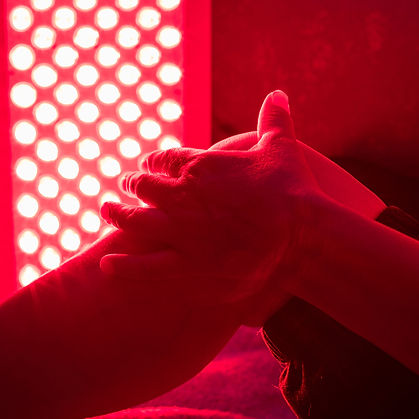
Our Near-Infrared Treatment is a type of red light therapy also known as photobiomodulation. It is a non-invasive therapy that uses very specific wavelengths of red light and near-infrared light that penetrate deep into your tissues to stimulate cellular energy production. This speeds up the body’s natural healing and repair processes. We use it as an advanced, targeted treatment combined with massage to help treat muscles, joints, nerves, and connective tissue to support faster recovery, alleviate pain, and enhance overall treatment results.
The result? Deep healing, faster progress, longer-lasting relief.
_edited.jpg)
RED LIGHT vs NEAR-INFRARED LIGHT - WHAT'S THE DIFFERENCE?
There is a lot of discussion out there lately about red light therapy and its various benefits. While several types of light therapy can be helpful, it is important to understand the specific technology we use here at Orthopedic Bodyworks. Both red light and near-infrared light are utilized to support healing, but they work at different tissue depths.
Red Light Therapy
(660 nm wavelength):
• Works more on the surface level
• Best for skin health, circulation,
lymphatic flow and superficial
tissue
• Supports overall wellbeing

Near-Infrared Light Therapy
(850 nm wavelength):
• Penetrates much deeper into muscles, fascia, joints, and nerves
• Targets pain, inflammation, and tightness at the source
• More effective for injury
recovery and chronic conditions

WHAT CONDITIONS BENEFIT FROM NEAR-INFRARED TREATMENTS?
Near-infrared light treatments are especially effective for:
✔ Chronic pain and tension
✔ Injuries (recent or old)
✔ Muscle fatigue or soreness from activity
✔ Joint issues or limited range of motion
✔ Nerve pain (sciatica, carpal tunnel)
✔ Fibromyalgia
✔ Swelling and lymphatic congestion
✔ Muscle spasms or stubborn tension
✔ Tendonitis
✔ Overuse injuries and repetitive strains
✔Postural tension
✔ Scar tissue
✔ Plantar fasciitis
✔ Menstrual cramps
✔ Digestive Issues
What to
expect during your session.
While most red-light sessions elsewhere are a stand-alone treatment, at Orthopedic Bodyworks we integrate the near-infrared light treatment directly into your massage session, so you still receive massage the entire time!!
During your massage session, your Therapist will use specialized near-infrared light pads or targeted lamps on specific problem areas. Rather than using full body panels, these focused treatments precisely target areas of concern for deep healing while giving the Therapist the ability to work on other parts of the body at the same time.
Your Therapist will begin by applying the light to your primary problem area(s). While the light is working (about 10-15 minutes), your Therapist will work on other areas. (ex: Near-infrared light treatment on your low back while the Therapist works on your shoulders and neck). As soon as the light treatment is complete, your Therapist will remove the light and do focused massage work on that area to release deep adhesions and help retrain the tissues for long-lasting results. If needed, the light can also be rotated to additional areas that could benefit from extra attention.
Most clients experience a gentle, soothing warmth while the near-infrared pad or lamp is in use. The treatment is typically very relaxing and many people notice overall tension release and comfort.
How quickly will I feel results?
Many clients notice immediate changes during the session, including:
• Easier movement
• Reduced tension
• Faster muscle release
For more complex or chronic issues, results build over a series of treatments. Most clients see significant improvement within 3–5 sessions, especially when treatments are scheduled close together.
How often should I receive treatments?
Your Clinical Massage Therapist will have a recommended treatment plan for you after assessing your condition. Chronic pain and injuries require a few to several sessions while receiving a treatment once a month helps with many issues as well.
For best results, we recommend:
For acute injuries (muscle spasms, joint sprains, disc flare-ups, and more):
• 3 to 5 treatments scheduled within 2 weeks. Used with 30 minute sessions.
For chronic conditions (low back tension, nerve issues, tendonitis and more):
• 1 treatment per week for 3 - 5 weeks. Can be used with 30, 60 or 90 minute sessions.
For general maintenance and overall wellbeing:
• Add-on to your monthly massage, any duration.
As Needed:
• Great for sore muscles, stubborn areas, tension headaches and stress!
Are there any side effects?
Near-infrared light treatments are considered very safe when used appropriately by a healthcare professional.
Negative side effects are uncommon but may include temporary warmth, itch or redness to the area in sensitive individuals.
Certain conditions require caution such as pregnancy, active cancer circulatory disorders, light sensitivity or implanted medical devices such as joint replacements.
All treatments are approached carefully and adjusted based on comfort and individual health history.
.png)
WHY CLIENTS LOVE IT
Clients choose near-infrared treatment because it:
• #1 - It’s a pain free, non-invasive treatment that targets problems DURING the massage
• Allows for deeper tissue work more comfortably
• Minimizes possible soreness the next day
• Speeds up recovery
• Helps results last longer
• Makes massage more effective overall
• Helps address the source of pain
• Often produces noticeable improvements in one session
If you’ve been dealing with ongoing pain, have a recent injury, or progress of healing has slowed, this is one of the most effective ways to move forward faster.